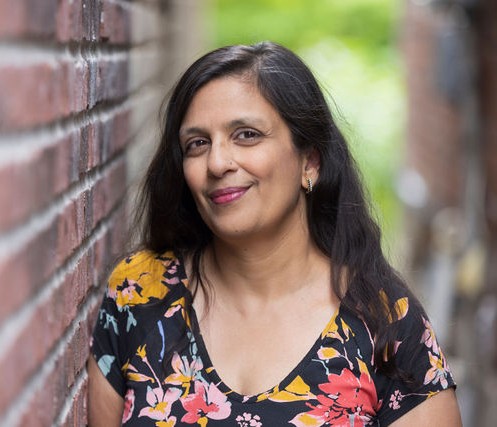
Sonal Champsee’s work appears in anthologies, magazines and newspapers, such as The New Quarterly, Today’s Parent, and The Toronto Star. Her debut novel, Everyone Can’t Be Wrong, was a finalist for the 2022 HarperCollins/UBC Prize for Best New Fiction. Sonal lives in Toronto, Canada.
The World is Awful, Buy My Book
I’ve always been at least mildly aware of politics—I remember my mom dragging 7 year-old me from house-to-house to knock on doors for a candidate—but politics didn’t become my favourite soap opera until the Rob Ford era here in Toronto. As wildly chaotic as things were then, it was in some ways a more innocent time. Barack Obama was president. Stephen Harper would soon be on his way out. Kathleen Wynne would soon come in. Jack Layton was alive. For a moment, we thought Justin Trudeau might really live up to his promises.
Then things took a dark turn.
I’m writing this blog for Brockton before the US midterms, and it’s scheduled to be published the day afterward, so I don’t know if we’re all breathing a sigh of relief or holding our head in our hands or if something absolutely batshit has happened. But the world is heavy. There have been bright pops of hope here and there, (bye-bye BradBrad!) but the big terrible things—genocide, war, climate change, the orange embodiment of the worst in humanity who is somehow in charge south of the border—remain big and terrible.
It’s an odd time to debut a book, especially one that addresses none of these things. I’ve been holding these dual narratives, that everything is terrible and also everything is amazing.
Alberta’s referendum voted to stay but also voted in support for a lot of anti-immigrant ideas. Independent booksellers are so kind and supportive and I love everything they do and why was I so afraid of talking to them? The online and often racist vitriol against the newly re-elected Mayor Olivia Chow may be mostly AI bots, but it’s so overwhelming and that normalizes these kinds of attacks. Watching people at Word on the Street pick up my book is awesome, and talking to readers about what I wrote and why may actually be the best thing ever. We’re moving to economic independence from the US through pipelines and data centres, and this is supposed to be the lesser of two evils? Total strangers who’d never attended a book event before came to my launch because they stumbled across the event, read the book blurb and it spoke to them enough to leave the house on a rainy Thursday; I’m so moved and also, everyone that rejected this book was wrong.
It’s easy to be cynical about politics, because there is frankly a lot to be cynical about. It’s easy to be cynical about publishing, because anyone in this business for more than five minutes can quickly see how what gets chosen and promoted and what gets rejected can be so arbitrary. I recently described a very popular book to a friend as being the pumpkin spice latte of literary fiction. It’s a decently written book, and it will undoubtedly have mass appeal in Basic Becky’s Book Club, and therefore it has been promoted and will sell in a way that my book never will. I don’t claim to have written the best book ever, but it’s no pumpkin spice latte.
Writing, for me, is the most amazing kind of a magic trick, where two human beings who might never meet can connect across time and space, and one can feel truly seen for a moment. We’ve all had that experience, of reading a book that spoke deeply to us in some way, as a catharsis of our own life experiences, or even simply bringing us into a new world. And it’s why books that aren’t quite the status quo are so important, because the connect with people who aren’t in Becky’s Book Club, although probably Becky and her friends ought to broaden their experiences by reading these books too.
Politics and political campaigning is not so different from the book business, in that it’s very much about human connection, albeit this particular soap opera directly affects our lives. But it’s how politicians connect (or not) with people that I find fascinating. Rob Ford didn’t win because he had good ideas. He had terrible ideas, but he connected to people who were as flabbergasted as he was about the workings of City Hall, and such connection still haunts Ontario politics today. Zohran Mamdani didn’t win because of progressive ideas; he won because he’s a New Yorker who loves New York, and he made authentic connections with other New Yorkers who’ve felt outside of politics as usual.
When this blog is published, we’ll know if everything is terrible or if everything is, well, probably not amazing but possibly a little bit better. Sweeps week is over, the ratings are in, but stay tuned for next week. Who knows what will go to shit next?
In the meantime, hopefully someone who has been outside the status quo of pumpkin spice latte books will pick up my novel, and maybe feel truly seen.
Leave a Reply