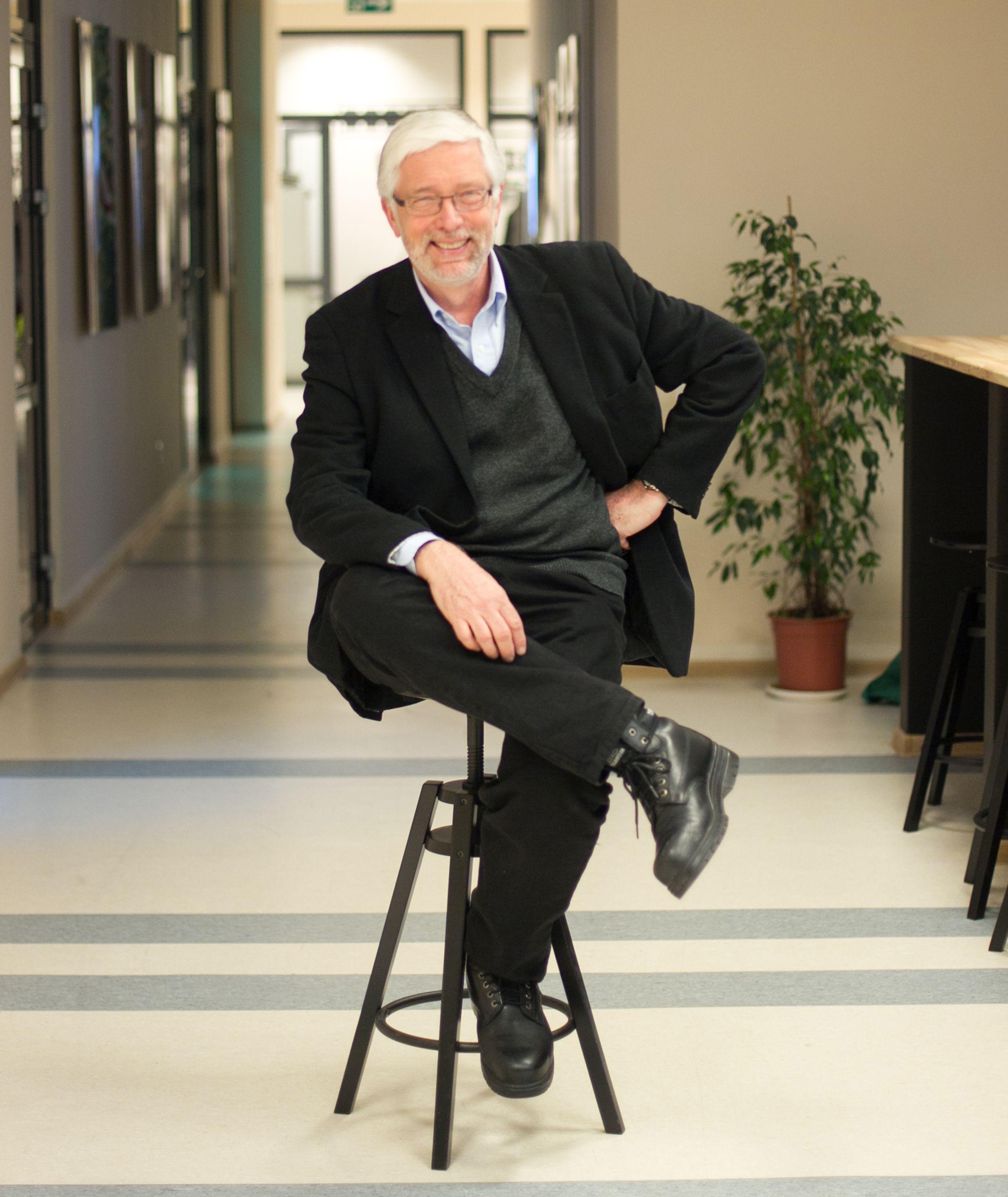
Antanas Sileika is the author of seven books of fiction and two memoirs; he’s been long-listed for Canada Reads and short-listed for the Leacock and Toronto book awards. He has been translated into three languages and had his work made into a fifteen-part radio drama and a European feature film.
The Seaside Café Metropolis
The Birth of a Novel

This comic novel is set in a Vilnius Café in 1959, a place with no seaside, and no metropolis, but there is indeed a café. It is a place where bohemians and artists gather during the Khrushchev political thaw of the times, but there is one difference between this fashionable café and other like it around the world. The KGB is listening through microphones set in the breadbaskets at each table.
My publicist described the novel as “A Gentleman in Moscow meets The Grand Budapest Hotel.” Writer Tamas Dobozy described the novel as “a culinary picaresque.” He said that because each chapter contains a Soviet-era recipe, ranging from Chicken Kiev to Napoleon cake.
So where did the idea for his novel come from? It all began at a real place, Vilnius’s historic Café Neringa.

Above, the interior of the historic Café Neringa in Vilnius, both as it appeared in 1959 and as it is today.
My introduction to the legendary Café Neringa in Vilnius, in the Lithuanian Soviet Socialist Republic, came in the summer of 1975. But I didn’t yet know the place was legendary.
I was the first of the family to visit Lithuania since my parents had fled the Red Army in 1944, so the trip was packed with latent emotion.
I had been turned back at the Polish border a week earlier due to a visa error and spent seven days trying to get the error corrected in Warsaw. Half a dozen of my Lithuanian relatives bought new bouquets of flowers daily and came to the train station but gave up after a week and went back to their homes in the northern city of Šiauliai. Now I was finally here in Vilnius, and they would soon come to meet me.
But in the meantime, there was the matter of breakfast.
Neringa was a very smart café, with a huge dining room and mosaics with a seaside theme, a middle section with a bar and fountain, and an intimate and charming street-front section. Not at all like the grimy train station cafés I had passed through in provincial Poland and the USSR.
The waitress handed me a thick menu book the size of a newspaper tabloid, with hundreds of items listed. There were many unusual dishes I thought I might try, so I asked first for the chicken in aspic.
The waitress told me they had none.
I looked down the menu and asked for sausages and eggs.
The waitress told me they had none.
This sort of exchange went on for half a dozen items with increasing exasperation on both parts until I came upon the unlikely availability of solyanka soup, a dish I’d never heard of at that time, made up mostly of cold cuts in a broth containing pickle juice. There was no coffee, but I could have tea with honey. The heavy black bread was good.
When my cousin’s husband came over to pick me up, he looked around the room with awe.
“What a place, eh?” he said after we’d made acquaintance.
“Sure,” I said. “But they didn’t have anything I asked for on the menu.”
“Did you choose from the checked boxes?”
It seemed that some Soviet menus contained all possible dishes, something like a Linnaean list with many categories and items, but only the ones available were marked by a pencil check in a tiny box. To the waitress, I had seemed like a moron, picking unavailable dishes. To me, the menu had looked like the culinary equivalent of a Potemkin village.
“This is the coolest place in town,” said Rimas. He didn’t get to the capital much, and he had clearly never been in this place before.
“What’s so special about it?”
“It’s a legend.”
“Legend for what reason?”
“Everybody who was somebody came to this place,” he said. “They still do.”
I didn’t know any of the Lithuanian somebodies in those days, neither the writers nor the artists, the musicians nor the actors. But I did get the idea that this was the iconic café of the city, as important locally as the Café de Flore or Deux Magots in Paris.
The café had been built in the late fifties during the brief Khrushchev thaw in the Soviet Union. Finally, bohemians and students had a stylish spot to go to, a place with jazz and wicked conversation. It was like all very cool places in the West, with this exception — there was a microphone at every table, and the KGB listened in to what all the bohemians were talking about.
Moscow poet and later Nobel laureate Joseph Brodsky met his local friend Tomas Venclova in that café. Decades later, Venclova pointed out to me the corner table where the turned former British agent Jonas Deksnys used to drink a small carafe of cognac each night. A writer all the way from Minsk once came in by taxi to taste the local atmosphere. Lithuania was like the West to Russians, and it exerted a sort of magnetic pull, and the attraction to Vilnius and the Café Neringa exerted the most powerful force of all.
Iconic places exist in time as well as in geography, so the café was already past its prime when I visited in in 1975. But the heyday came back to life in my imagination when I read a book of memoirs about those who had spent time in the café.
This reading was followed by conversations about the place with Aušra Marija Sluckaite-Jurašienė, a writer later expelled from the Soviet Union with her husband, the theatre director Jonas Jurašas. Gregory Talas, now a resident of Toronto, told me he once played the double bass in the café jazz band. The late Jonas Žiburkus told me about his first mother-in-law who worked there under the direction of a manager called “The Argentinian,” an expatriate who gave up his life in South America to return to the budding socialist paradise of the USSR.
The Café Neringa was such an important cultural landmark that when the hotel enveloping it was torn down early in the twenty-first century, the original café part was preserved and the new hotel was built around it.
When my contemporary world locked down during the pandemic, I found myself stranded in Vilnius for six weeks, and the keyboard under my fingers compelled me to start creating the world of The Seaside Café Metropolis, a café that became the fictional twin of the historic Café Neringa.
Some of my novel’s scenes are inspired by Neringa history as described in Neringos kavinė: sugrįžimas į legendą by Neringa Jonušaitė. These include the visit of Jean-Paul Sartre and Simone de Beauvoir in the company of Antanas Sutkus, a fine photographer whose photos of Sartre led to the creation of a Sartre statue placed improbably on a sand dune on the Baltic coast. Former spy Jonas Deksnys, described in his biography as a “tired hero,” was a regular there. I also adapted the true story of the tragic photographer Vitas Luckus, who owned a pet lion and who leaped out of his apartment window after fatally stabbing a friend.
Kas Tikro, (from publisher Aukso žuvys), a book of essays on historical themes in the Soviet period, had vivid descriptions of bohemian life in Vilnius’s so-called Bermuda Triangle. Another important book to give me a feeling of the place at that time was Déjà Vu Vilnius, by Inga Liutkevičienė. Thanks to Inesa Gailienė for finding a way to get that text to me.
Those were real life inspirations, but I had some literary ones as well. The birth of the conceit of bohemia could arguably be traced back to Henri Murger’s 1849 novel, The Bohemians of the Latin Quarter. That novel was enormously popular in its day, and the stories were adapted into the opera La Bohème. The four rapscallion artists and philosophers in Murger’s novel have evolved to my four young bohemians in The Seaside Café Metropolis, and the tragic death of my Mona echoes the tragic death of Mimi from the opera. I should add that Mona’s back story was based on the astonishing true story of the late Nelly Paltinienė, a Lithuanian singer who lived like a waif through the Second World War in Poland, with her father conscripted and her Jewish stepmother murdered. She went on to become a pop darling of Soviet Lithuania.
How is it possible to live in freedom under tyranny? One must create a sort of fantasy world to shield at least part of oneself from the oppression. And under this shield, people can create alternative lives for themselves, real or imaginary.
A recent book club had me discuss the novel with its members as we were served the dishes above, all of whose recipes appear in the novel.
Leave a Reply