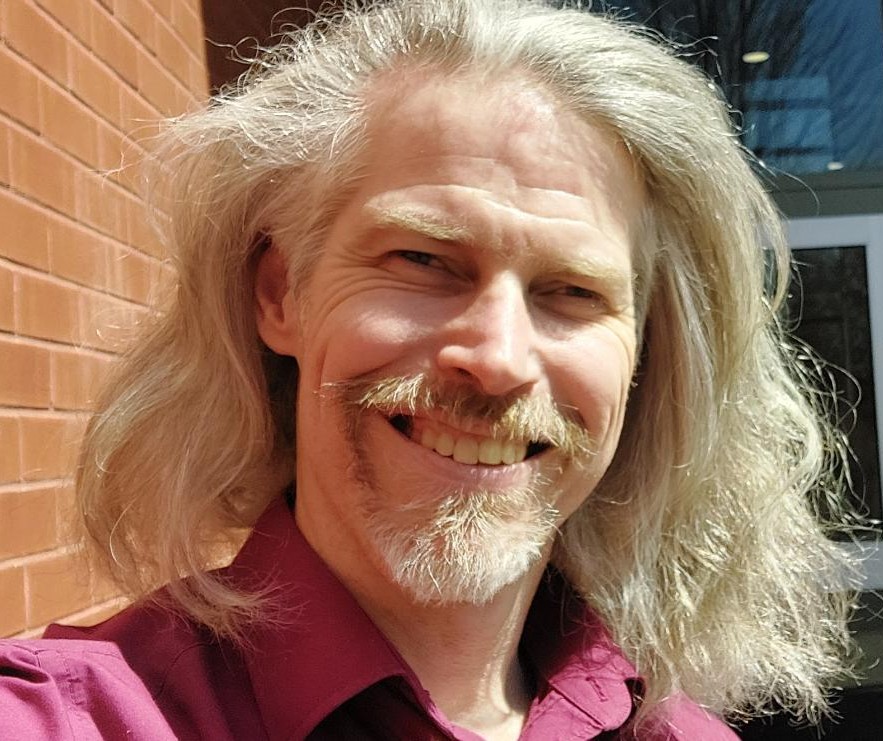
Ottawa writer James K. Moran writes across genres, with poetry and speculative fiction in Burly Tales, Bywords, Glitterwolf and On Spec, and reviews in Arc Poetry Magazine, Plenitude and Strange Horizons. Lethe Press published Moran’s short-story collection Fear Itself and horror novel Town & Train.
An Insomniac’s Dispatch About Voice
Pssst! I’ll let you in on a writer’s secret, if you’ll indulge me. At 3:15 a.m., with colours mirage-shimmering under my eyelids, I can question a lot. Overthinking, as I do, I ask, Why keep writing at all?
Look at that curtain rod beside the bed. The folds in the curtains, like some nocturnal wildebeest, mouth agape, the hoops like eyes. These are the very same outre night-time visions that stoked my imagination as a kid. I lit upon classical Universal monsters, lurid Weird Tales magazine covers, and the comic-book power fantasies of Superboy and Captain Marvel. Holy grails, all.
My co-pilot (wife) had just returned from a three-week speaking tour. While they were away, I had ups and downs and all around. I was tapped out more evenings than not. She had been home a few days now. Why was I awake, watching colours perform a phantasmagorical dance under my eyelids? Why was I questioning my voice?
I have been lucky enough to push my small-town Canadian horror novel Town & Train and short story collection Fear Itself out into the world through US publisher Lethe Press. It wasn’t precisely impostor symptom now, I guessed, but residual stress and self-doubt, not having placed new work in many moons.
I’ll admit it. Being a fixed point while my co-pilot gave talks about the International Day of Pink and seemingly everything on the homefront going wrong made my anxious. I was ashamed and embarrassed even while I experienced these lows. So tired was I during those weeks, running the homefront with our seventeen-year-old and working the day job, that I may have quit writing. Three times. I may have posted woefully on social media (I wrote zero words today). However, I soon retracted my posts after three longtime friends’ prompt and lovingly chastising replies: These days happen. LOL! and It’s only 8:15 p.m.! and You and me both, buddy 😉
I’m not saying anyone should quit writing. I’m saying that questioning your voice can come at any stage in your writing vocation.
During the past fifteen years, I have often asked what I bring to the page or screen. And, here I am, in bed, turning from side to side, then onto my back, mind pacing ahead of me. The ceiling, an inscrutable slate-grey. The sheets, a rumple, maybe too warm.
And the resulting secret I want to share?: What you bring to the page or screen is you. Your observations, your youness, informs the writing.
As British American spec-fic writer Peter Atkins told me once, even a well-used theme can blow a reader’s hair back if handled cleverly, intelligently and personably. In the 1940s, Ray Bradbury was attempting to break into the pulps, writing like a mad person. But only when he lit upon tying the work to youthful trauma in the story “The Lake,” about his real-life friend Tally who had drowned, her body never recovered, did he have a watershed breakthrough. Bradbury’s first published piece appeared May 1944 in Weird Tales. From then on, the “Mole’s” writing was intensely personal, while still fantastical and genre defiant.
Myself, I was born in Kingston, moved to Cornwall, Ontario, when I was four, growing up in the often mean streets of a city that acts like a town in terms of provincial wisdom. It’s a mix of Indigenous influence from the Akwesasne Reserve, a significant Francophone population, a growing seniors and immigrant population, all in a storied border town with a bête noire media presence. But I digress. I got out, attended university, hitchhiked some, lived in London, England, for a spell in 1998, hitched some more in Scotland near Loch Ness, and traveled Canada upon my return, by train and antique fire truck.
The above bio misses the roughshod restless twenties of a closeted, bi poet and writer couch-surfing and uneasy staying in any one spot for too long, or any of the other many details of my life. Which all add up to the DNA of my writing, as your story makes up yours.
In my work, you’ll find plenty of small-town horror, with surrounding forest, perhaps a sepia-toned streetlight on Cornwall’s post-midnight Tollgate Road. Tommy Twotrees will come over from Akwesasne, trying to bail out the sheltered, white kids in over their heads in Train. Henry Tanner, my hard-nosed, retired firefighter, might step in to lend a hand.
My bi mage James Harker tries to make a throuple work in my short story “James Harker tries to have the talk.” In another story, a sea serpent lurks in the waters of the St. Lawrence River under the sixty-year-old Seaway International Bridge. In another, a rumpled John Newman stumbles past the legendary Centretown Pub, one of Ottawa’s first queer bars, which stood on Somerset Street for over three decades.
I was about to say that everyone’s got something, as writer rob mclennan says. It’s that something that you need to hammer into a shape, whether poetry, prose of any genre, or non-fiction. I write them all. You don’t have to stick to one genre or form. Why limit yourself? Crossing genres worked for Ray Bradbury. It works for Margaret Atwood. It can work for you, too.
Gliding towards sleep, I wonder if maybe the questioning process is good. It can motivate us to redouble our efforts, and can alchemize our prose. When you return, after some time, to edit a piece, it can read like someone else wrote it. You will wonder whom you were channeling then, alive or dead, or in the room with you or not, when you scratched out that particular insight. You may be surprised, humbled, even. You won’t remember the questioning from when you wrote it. But, you should be thankful you committed it to print.
On my blog, I write about writing, life and my passions at jameskmoran.blogspot.com.

Leave a Reply